Digital Container Management 4.0: The Partnership of SmartMakers and LOGSOL
Monitor containers more efficiently ✓ digitally connected load carriers ✓ reduce costs through container management 4.0 ✓ Read the article now!
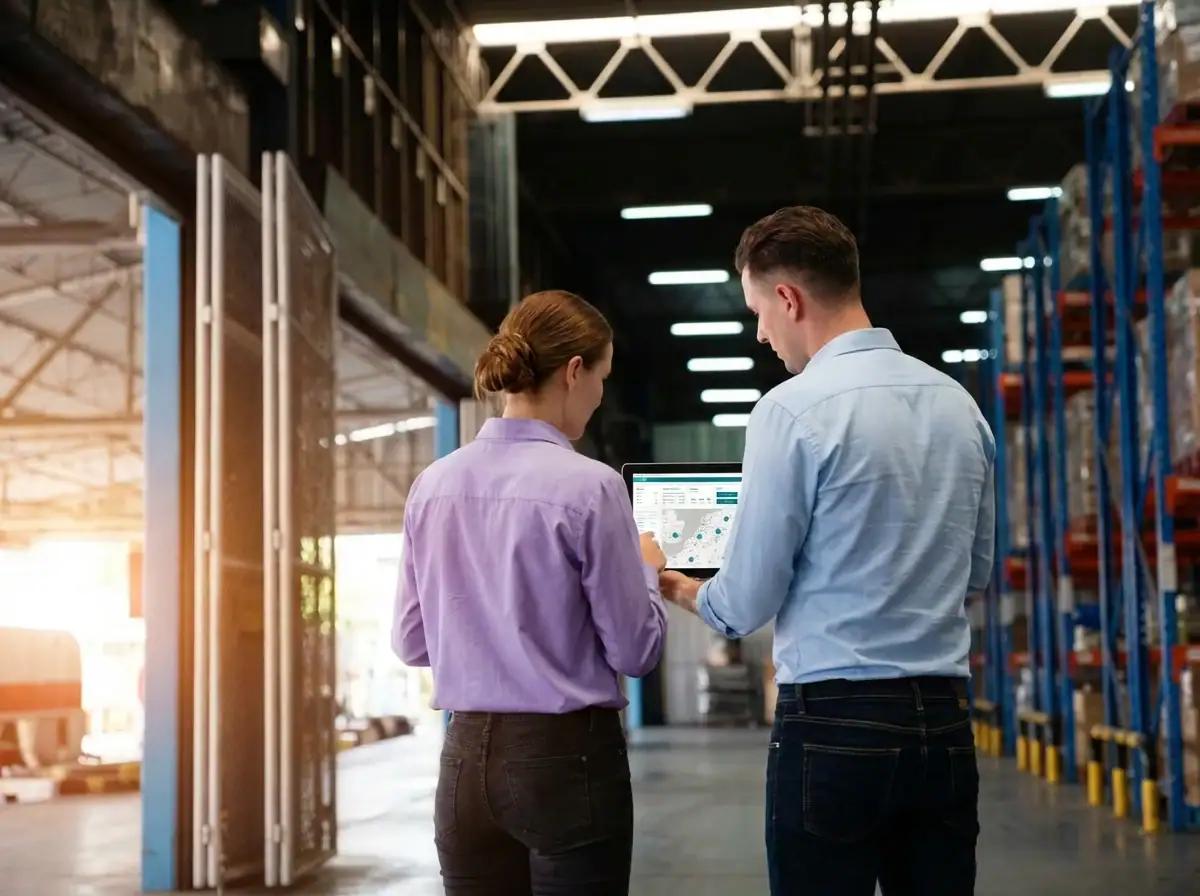
In modern industrial manufacturing, load carriers are far more than simple means of transport: They are the physical foundation of the entire supply chain. Without a smooth circulation of containers, material flows, production units, and ultimately delivery to the customer come to a halt. Despite this central importance, many companies struggle with significant lack of transparency in their container cycles.
At this critical point, the strategic cooperation between SmartMakers and LOGSOL begins. By combining state-of-the-art IoT technology with profound process expertise, the vision of transparent, connected, and proactive logistics becomes a reality.
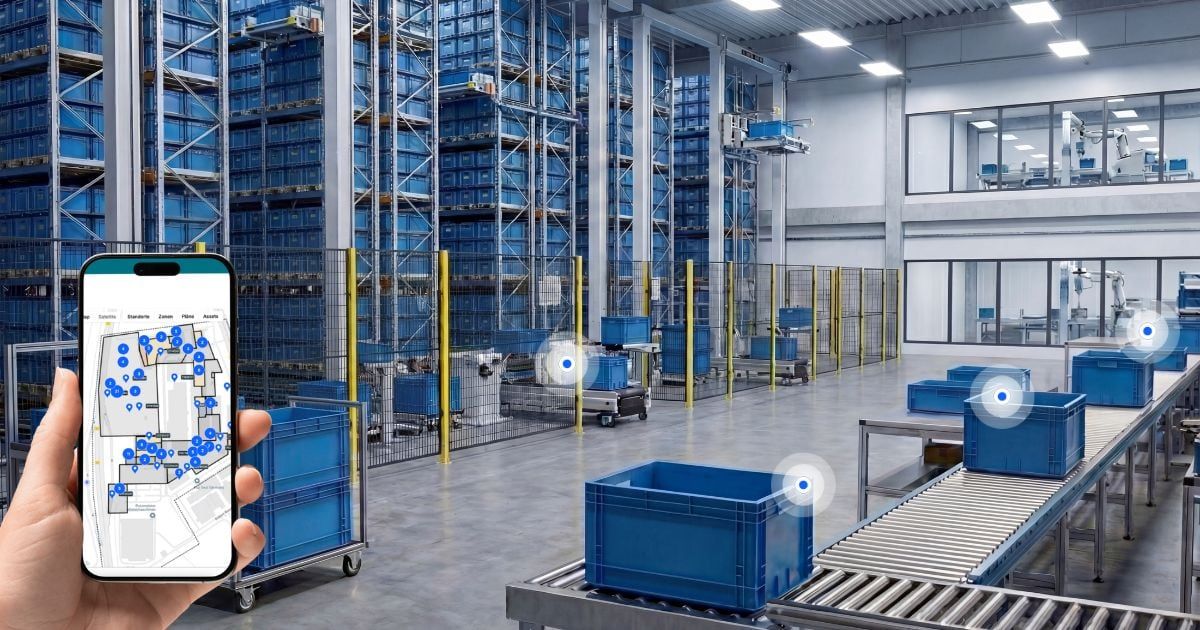
Digital load carrier tracking within the partnership of SmartMakers and LOGSOL.
Challenge: The "blind spot" in the supply chain
Many companies still rely on manual bookings and paper-based processes to manage their container cycles. In the operational hustle and bustle of everyday life, this inevitably leads to gaps: Containers are not recorded, data is entered incorrectly or simply forgotten.
The consequences are severe for the efficiency of the entire company:
- Unnecessary capital binding: To remain deliverable, expensive safety stocks are often created or unnecessary new purchases are made.
- Discrepancy in actual inventory: The inventory shown in the system does not correspond to physical reality.
- Misplanning: Uncertainties lead to incorrect dispositions and unclear planning bases.
The path to digital container management 4.0: How LOGSOL and SmartMakers work together
The partnership between LOGSOL and SmartMakers addresses these issues through a perfect technological symbiosis. A system is created that not only manages containers but makes them intelligent actors within the value chain.
SmartMakers provides the crucial technological foundation for the digitization of physical objects through the use of:
- IoT Trackers: These continuously capture data directly on the load carrier.
- Low-Power Wide-Area Networks (LPWAN): These enable energy-efficient and long-range data transmission that works stably even in complex industrial environments, such as large manufacturing halls.
- the thingsHub platform: As a central element, this platform intelligently connects the objects, makes all data available in real-time, and enables active control.
“Our customers can significantly simplify numerous operational processes, allowing them to deploy employees for truly value-adding processes.”
– Julia Bayer, Co-Founder, SmartMakers
LOGSOL complements this technological foundation with decades of experience in logistics consulting and process optimization. With the platform BinMan®, LOGSOL offers:
- Standardization: A tool that standardizes container processes across locations.
- System integration: Direct interfaces to existing ERP systems ensure that IoT data seamlessly integrates into business logic.
Through automatic digital tracking, transparency is created over the entire cycle. Companies can reduce inventories to the necessary minimum, as reliable facts replace previous assumptions. This prevents unnecessary overstocking and expensive repurchases due to container loss. Capital that can be reinvested in new technologies and innovations.
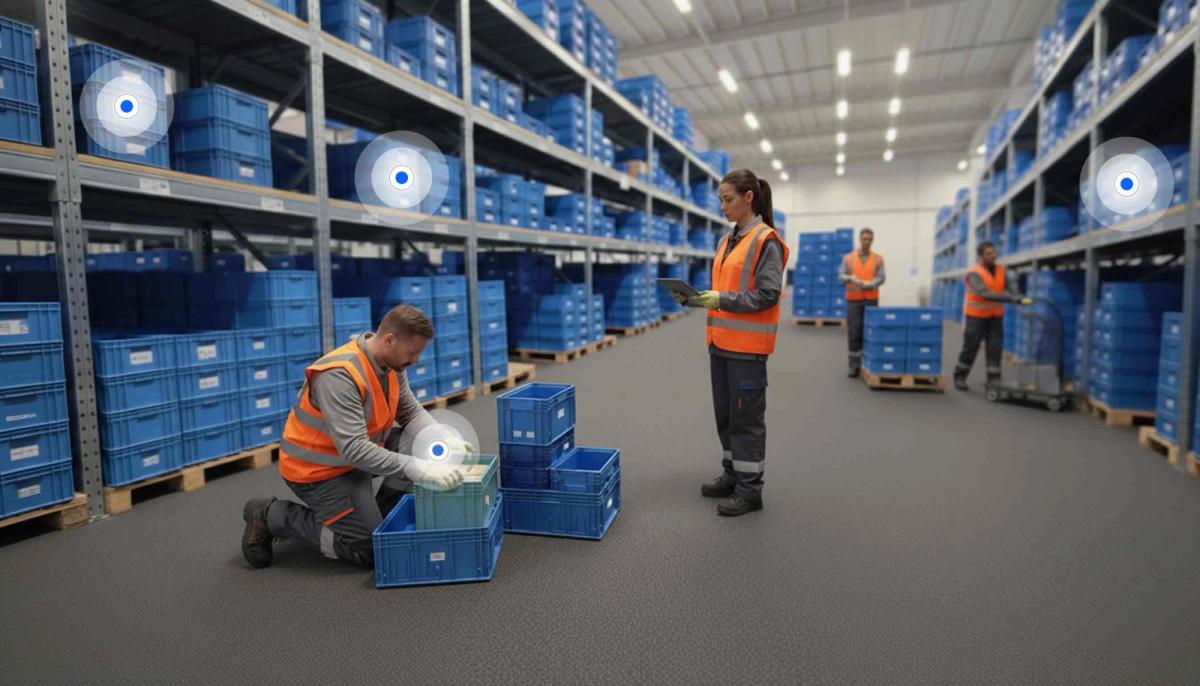
Real-time transparency: Every location change and usage state becomes immediately digitally visible through modern IoT sensor technology.
Operational added value: From assumptions to reliable facts
Through the automated digital tracking realized jointly by SmartMakers and LOGSOL, measurable advantages arise for customers. Instead of relying on estimates, decision-makers receive a solid data basis. Those who previously could only hope that the existing containers could cover the order volume will know for sure in the future.
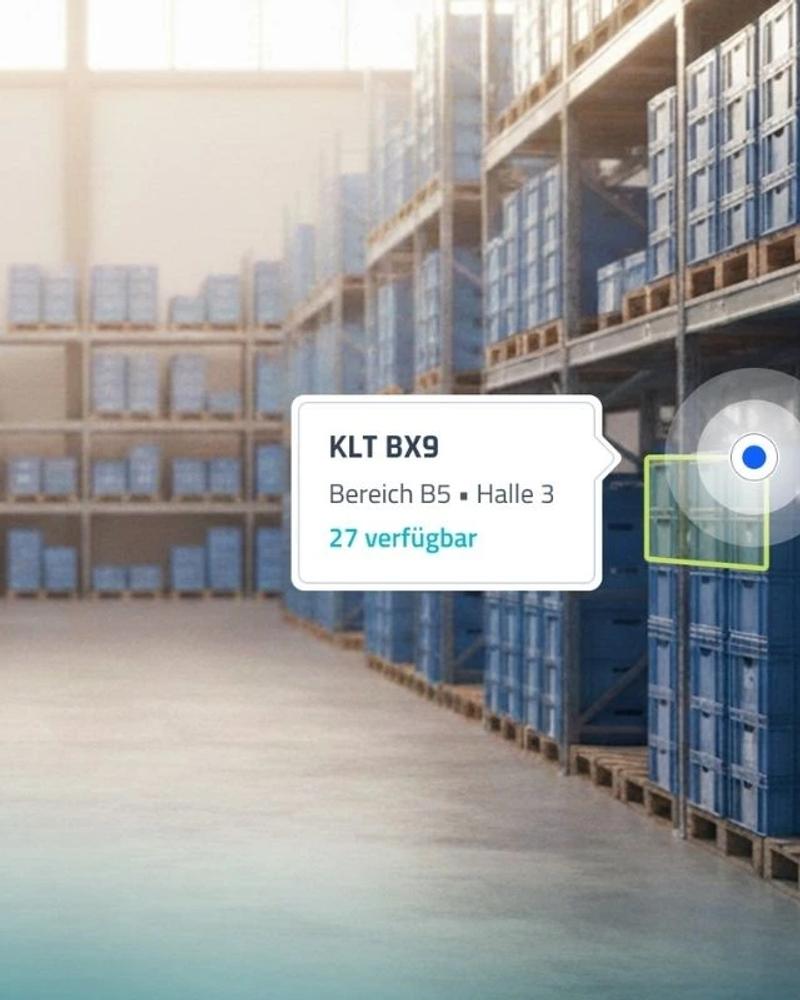
- Real-time transparency over the entire cycle: Every location change, every usage state, and even the physical wear of the containers can be visualized in real-time. This allows bottlenecks to be identified early before they disrupt the material flow.
- Reduction of inventories and costs: When the real position of each container is known, the need for overstocking out of pure caution is eliminated. Companies can purchase specifically and as needed, significantly reducing tied-up capital.
- Scalability with existing staff: The shortage of skilled workers is an omnipresent issue. Many companies in the industry lack the personnel to continue growing. Another perspective reveals that these companies suffer less from a shortage of personnel and more from a lack of technology. With the right digital support, the problem can be solved, creating the basis for efficient scaling.
- Sustainability through longevity: The solution makes a direct contribution to sustainability. By reducing container loss, unnecessary new purchases are avoided, conserving resources and improving the ecological footprint of logistics.
Video on Container Cycles 4.0
In the following video, Holger Marggraf explains the container cycles in logistics. He addresses the challenges of existing structures in container management and explains the advantages of the new concept.
“Transparency is the new currency in logistics. If I know in real-time where my containers are, I plan differently, dispose differently – and save real money.”
– Andreas Weber, Product Manager, LOGSOL
A Day in the Life of Container LS-2106
To illustrate the practical benefits, it is worth taking a look at the digitized everyday life of a load carrier:
- Automated recording: The container LS-2106 is transported from the warehouse to production in the morning. Through automatic localization and geofences, this transition is account-based recorded. No manual booking or pushing through physical gates is required. The status is immediately visible in the BinMan® overview.
- Continuous monitoring: During the journey, the container continuously sends data on location, condition, and temperature. If a defect occurs, it is immediately detected by the system.
- Automated feedback: After its use, the container automatically reports back to the empty goods warehouse. It is immediately available for the next cycle, and the dispatcher always has an overview of the available capacities.
In this scenario, the container itself becomes an active part of the process and thus an intelligent logistics actor.
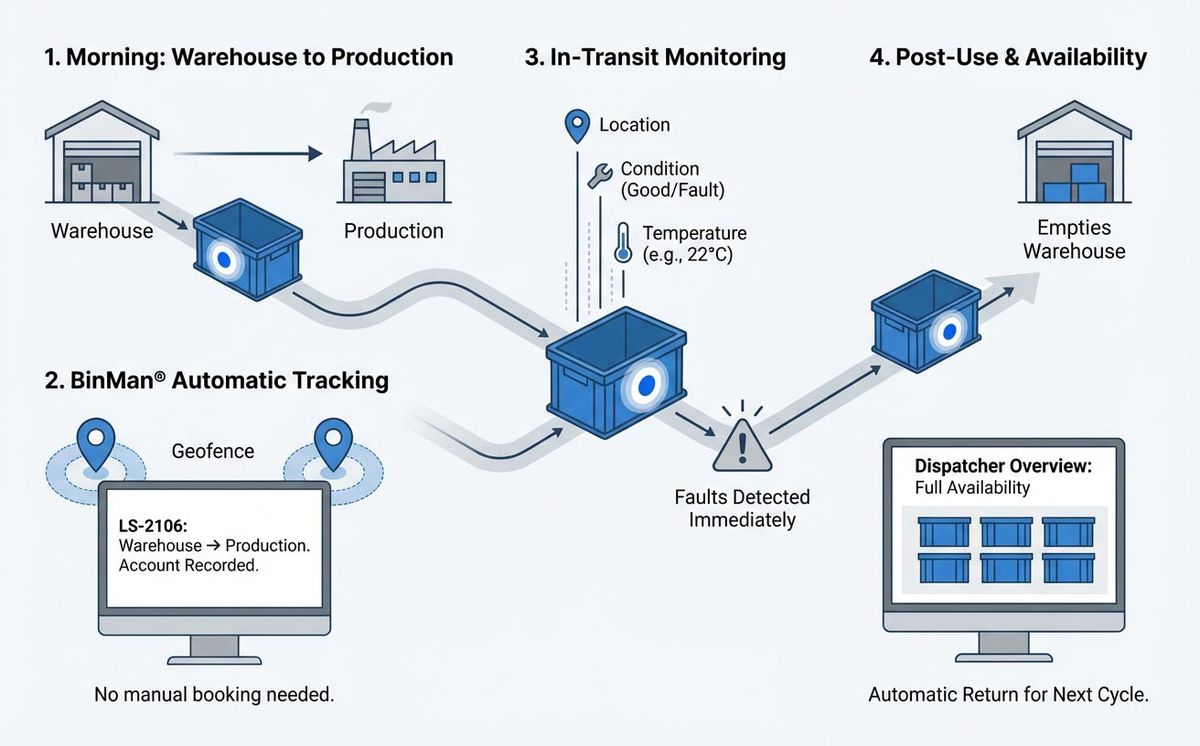
Digital container management in practice: The automated cycle of a load carrier
The partnership of SmartMakers and LOGSOL impressively demonstrates how a new level of efficiency in logistics can be achieved through the combination of IoT technology and process expertise. Companies not only regain control over their inventory but also lay the foundation for a proactive and sustainable supply chain. When data is available in real-time, operational processes become simpler, more transparent, and more cost-effective
SmartMakers and LOGSOL are already shaping the connected future of container management.
Your containers travel between plants, suppliers, and customers - but no one knows exactly where they are?
Contact us for a non-binding consultation. We help you optimize your container management.