What is a LoRaWAN Gateway and How Does It Work?
Learn how a LoRaWAN Gateway connects IoT devices, transmits data, and offers cost-effective, scalable networks.
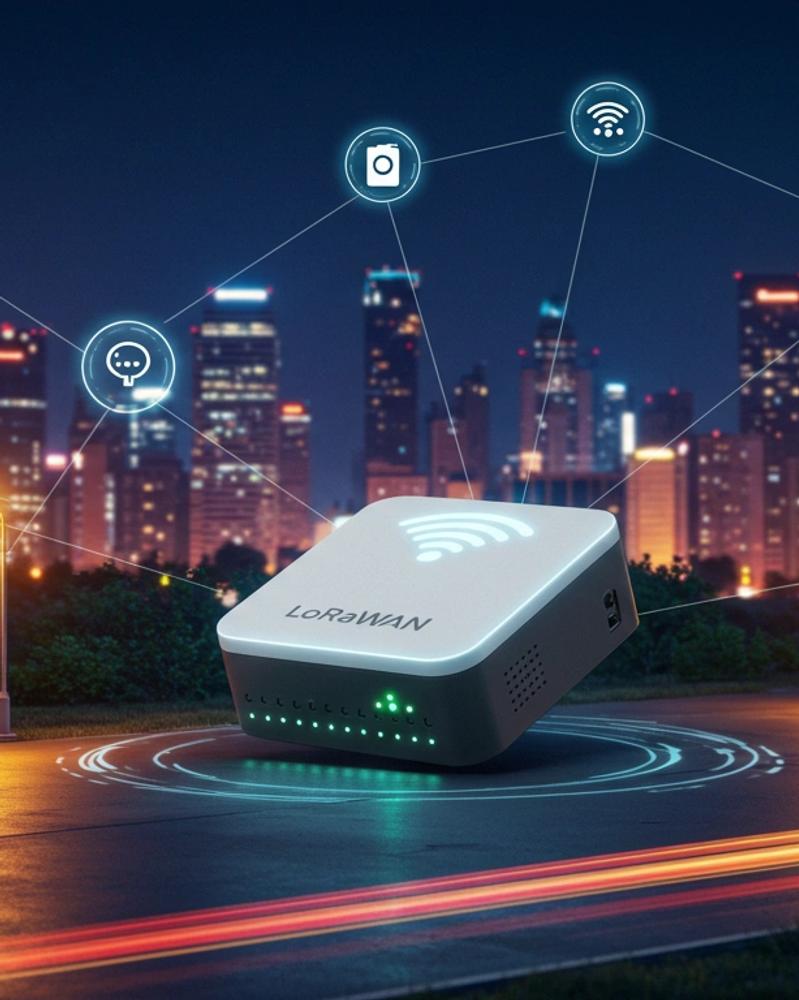
LoRaWAN (Long Range Wide Area Network) is a communication protocol developed for energy-efficient and long-range connectivity in IoT networks (Internet of Things). By utilizing the LoRa modulation technique (Long Range), devices can transmit data over long distances without consuming much energy. This combination of range and efficiency makes LoRaWAN particularly attractive for applications in Smart Cities, agriculture, industrial monitoring and asset tracking.
A central role in the system is played by the LoRaWAN Gateway. It acts as a bridge between IoT end devices and the central network server. Gateways receive data collected by sensors and reliably forward it, ensuring stable, scalable communication. Without this intermediary, a comprehensive IoT network would hardly be possible.
What is a LoRaWAN Gateway?
Basic Functionality
A LoRaWAN Gateway connects LoRa-enabled end devices with a cloud-based network server. It receives high-frequency signals (RF) from IoT sensors, converts them into digital data packets, and transmits them over an internet connection – such as via Ethernet, Wi-Fi, or cellular. It also sends downlink messages from the server to the respective end devices. Without this bidirectional bridge, IoT devices could only communicate very limitedly with each other.
Key Components
A typical LoRaWAN Gateway consists of several central elements:
- LoRa radio module: Enables communication with IoT devices over long distances.
- Network interface: Transmits data via Ethernet, Wi-Fi, or cellular.
- Processor: Processes, filters, and forwards incoming data.
- Antenna: Ensures stable signal transmission and high reception.
- Power supply: Depending on the use case, powered by grid, battery, or solar.
These components work together to create a reliable communication network that functions precisely and stably even over long distances.

Indoor vs. Outdoor LoRaWAN Gateways
Indoor Gateways
Indoor Gateways are designed for use in enclosed environments such as offices, production halls, or warehouses. They are compact, require little energy, and have lower transmission power. They are often connected to the internet via Wi-Fi or Ethernet – ideal for smaller networks with short range.
Outdoor Gateways
Outdoor Gateways, on the other hand, are specifically designed for outdoor use. They have weatherproof housings, powerful antennas, and robust connectivity options. This makes them ideal for agricultural applications, city-wide IoT infrastructures or industrial automation. Their design is intended to work reliably even under extreme weather conditions.
Key Differences
- Range: Outdoor Gateways offer a significantly greater signal range than indoor models.
- Durability: They are designed for use in harsh conditions, while indoor devices are intended for stable environments.
- Connectivity: Outdoor models often have cellular backhaul to ensure a stable connection even in remote regions.
These differences are crucial when selecting the right gateway for a specific IoT project.
How does a LoRaWAN Gateway work?
Signal Reception and Transmission
The gateway continuously "listens" to the radio signals of IoT devices that send information such as temperature, movement, or system status. These analog signals are converted into digital packets suitable for further processing. Thanks to the high sensitivity of a gateway, even very weak signals can be received over long distances.
Data Processing and Forwarding
After reception, the gateway filters out duplicate or erroneous transmissions and forwards the cleaned data to the network server via an internet connection. The server analyzes the data, stores it, and makes it available to the respective application – such as a dashboard displaying the current status of all sensors.
Communication Protocols
The LoRaWAN protocol is used for communication between devices and the gateway. For data transmission to the network server, standardized, IP-based protocols such as MQTT or HTTP are used. Since LoRaWAN operates asynchronously, devices only send data when necessary. This keeps energy consumption minimal – a crucial advantage for battery-powered IoT devices.
Why LoRaWAN Gateways are Indispensable for IoT Applications
Scalability
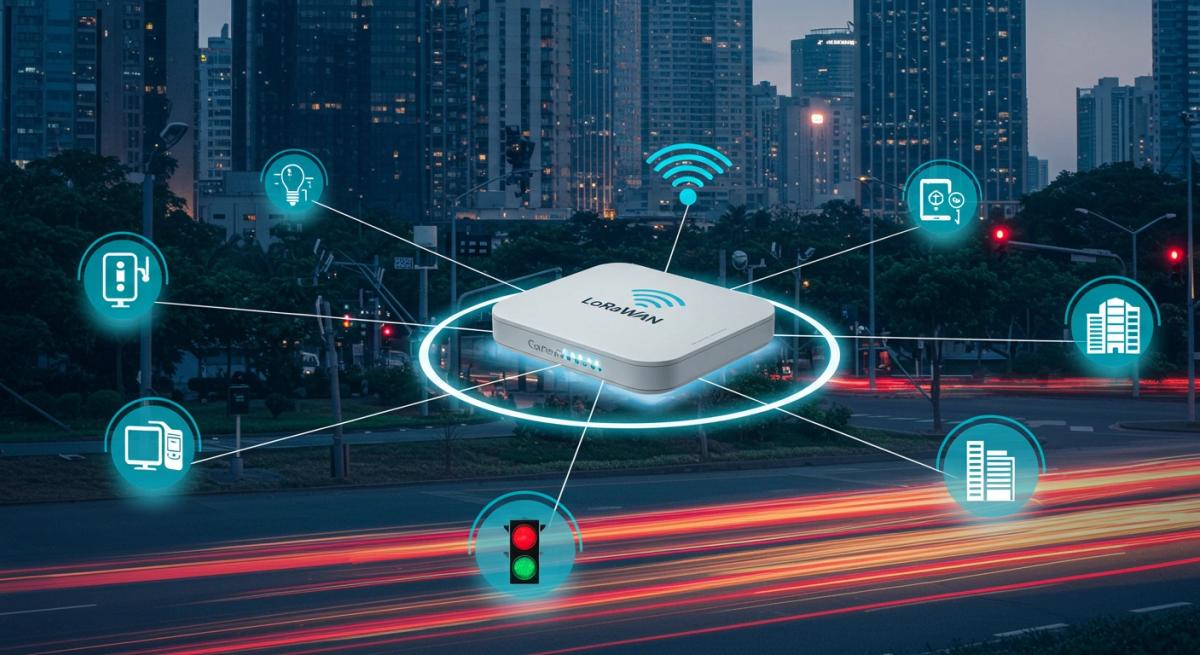
A LoRaWAN Gateway can serve thousands of end devices over long distances. This allows even extensive networks to be set up with relatively little effort – for example, for smart city projects or industrial facilities. The ability to connect many sensors via a single gateway significantly reduces infrastructure costs.
Flexibility
LoRaWAN Gateways are extremely versatile. They work equally reliably in urban and rural environments and can be adapted to a wide range of scenarios – from monitoring machines in production to controlling environmental parameters in agriculture.
Cost Efficiency
Compared to cellular-based IoT solutions, LoRaWAN networks are significantly more cost-effective. Since LoRaWAN operates in unlicensed frequency bands, there are no high license or usage fees. Companies can build their own networks that are scalable and economically viable in the long term – a crucial advantage for large-scale IoT implementations.
Key Considerations When Choosing a LoRaWAN Gateway
When selecting a suitable gateway, you should consider several key factors:
- Location: Indoor or outdoor model, depending on the environment and range requirements.
- Network connectivity: Compatibility with Ethernet, Wi-Fi, or cellular.
- Signal range: Powerful antennas are crucial for stable transmissions.
- Power supply: Grid, battery, or solar operation – depending on the use case.
- Scalability: Check how many devices a gateway can support simultaneously.
These criteria largely determine whether a LoRaWAN network operates reliably and efficiently.
Final Thoughts
LoRaWAN Gateways are the backbone of modern, energy-efficient IoT infrastructures. They enable communication over long distances and reliably connect IoT end devices with central network servers.
The choice of the right gateway depends on many factors – including location, range, power supply, and integration capability. While indoor gateways are suitable for smaller, controlled environments, outdoor gateways impress with robustness and range for large-scale applications.
Another advantage of LoRaWAN is its economic scalability. Since the protocol is based on license-free frequency bands, companies can build and expand their own networks cost-effectively.
With the ongoing digitalization and the increasing demand for energy-efficient connectivity, the importance of LoRaWAN Gateways will continue to grow. Companies that adopt this technology early on gain a clear competitive advantage – through lower operating costs, higher transparency, and a future-proof IoT infrastructure.