AI in Logistics: A Workday with an AI Agent
Agentic AI is newly featured in the DHL Logistics Trend Radar 8.0 and was unsurprisingly rated with high impact. At first, this sounds like the next buzzword being driven through the production hall. Reason enough to get up close and personal with what an AI agent can really achieve in logistics.

The most interesting aspect is DHL's own assessment: Because without real-time data from sensors, AI agents in logistics do not function reliably.
But let's start from the beginning: You've probably tried ChatGPT, Claude, or Gemini before. For an email, a funny picture, an evaluation, or even with a screenshot from the software to develop a solution proposal. That works well too.
AI agents in logistics and production, on the other hand? It's still pretty quiet in most companies. Time to take a closer look at the difference between chatbots and AI agents.
Chatbot or AI Agent: What's the Difference?
A chatbot is like the colleague who knows everything but only responds when asked. You send him a screenshot from the ERP in the chat and get a meaningful suggestion. The problem with the whole thing: you have to notice beforehand that something is wrong. To be honest: when you notice that something is wrong, the house is usually already on fire.
An AI agent, on the other hand, is more like the shift supervisor who makes his rounds before anyone calls. He keeps an eye on a specific area, such as material provisioning or line supply. If something doesn't go as planned, the AI agent reports with a concrete suggestion. What he is allowed to do and what not is determined at the beginning. But you still have the final say. Even with AI, you can't do without a boss.
How working with an AI agent feels in reality is best shown by a completely normal morning.
A Morning in Production Logistics with an AI Agent
6:00 AM, Shift Handover: The Night at a Glance
You take over the early shift and the shift book is, as always, only sporadically maintained. You learn what happened during the night bit by bit throughout the morning. It's different with the AI agent, as he is already waiting with a summary for you.
“Since 10 PM, two order boxes have not moved. You need both for today's orders. Recommendation: Trigger transport order to avoid production delays.”
What you gain: Every order starts with the material that is needed.
8:15 AM, Goods Receipt: The Parts from the Hardening Shop Are Back
The parts have been placed in the yard and are ready for use. However, the ERP is firmly convinced that they are still with the supplier. Anyone who has ever waited two days for a booking in goods receipt knows: Paper is patient. Unfortunately, ERP systems are too. The reason is that the parts cannot book themselves without appropriate sensors.
For the example with the AI agent, we assume that the data was booked correctly.
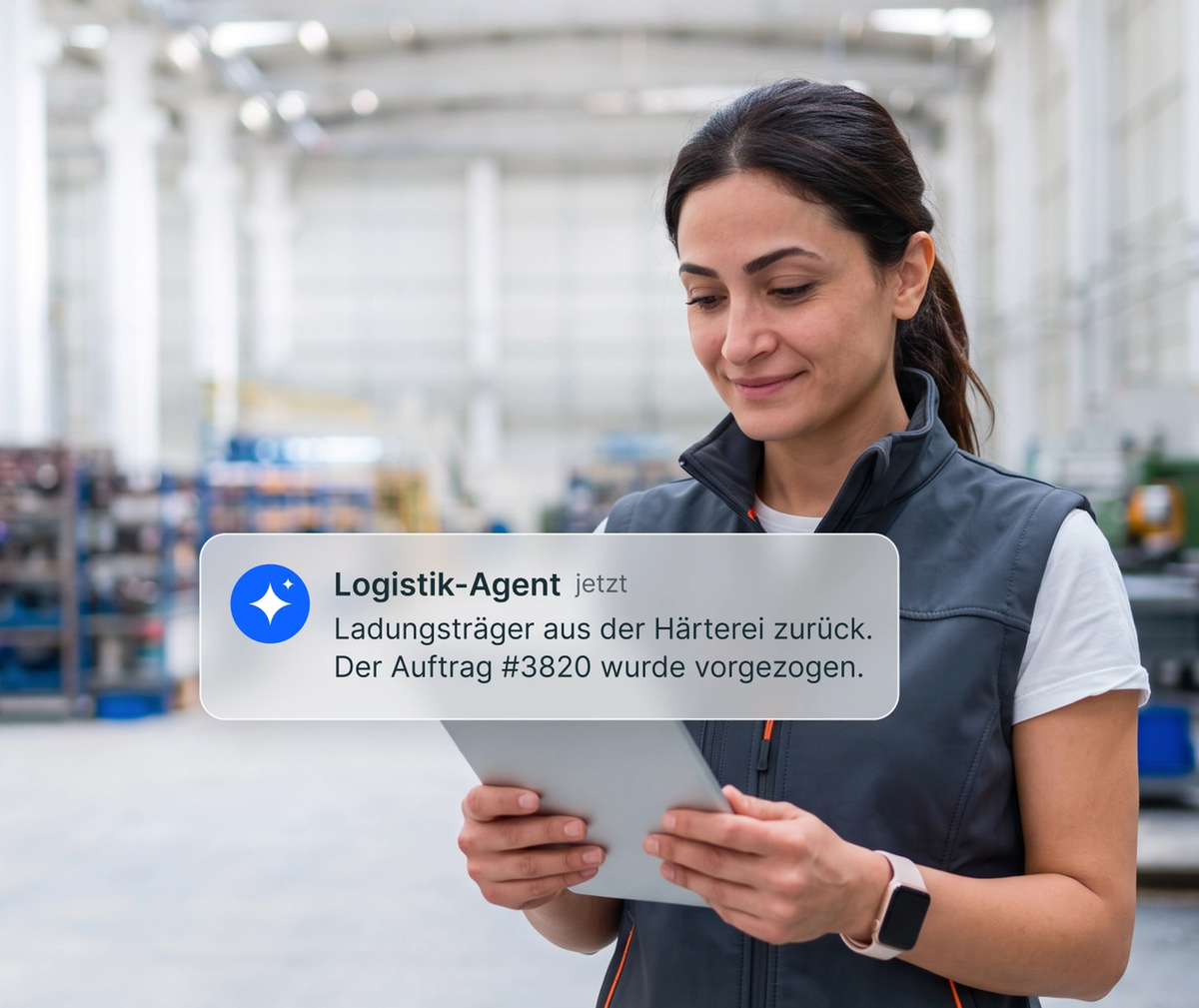
“Three load carriers from the hardening shop arrived on the factory premises at 8:02 AM. Order #3820 has been waiting for these parts for two days. Recommendation: Release order and prioritize in assembly.”
One click is enough and the assembly sequence is adjusted.
What you gain: Assembly can start faster, avoiding production delays.
9:00 AM, Material Provisioning: Two Assemblies in the Wrong Hall
At 9:30 AM, the next order is supposed to start at assembly station 2. The material is there. Only no one knows where it is right now. Normally, the scavenger hunt through the halls begins now.
It's different when the material is equipped with appropriate sensors and an agent makes suggestions to you:
“Two of seven assemblies for order 4711 are still in hall 4, buffer zone B. The transport takes about 40 minutes. Recommendation: trigger now.”
You trigger the transport and end the scavenger hunt before it even begins.
What you gain: Assembly starts on time. No one has to run through the halls searching.
11:30 AM, Line Supply: KLT Are Running Low
Line 3 is running really well today. That's a reason to celebrate, as long as the empty KLT don't become a problem. That's exactly what's threatening right now.
“At line 3, the empty KLT will last for about 90 minutes. There are 60 free KLT in the south buffer warehouse. Recommendation: Redistribution with the next route train trip.”
You confirm. The route train picks up the KLT on the next round. No one has to frantically reach for the phone.
What you gain: Line 3 runs continuously and supply is secured by early return.
The Foundation for AI Agents: Real-Time Data from Production Logistics
Sounds like a relaxed morning, doesn't it? It's not because the agent is particularly smart. He simply knew at all times where order boxes, load carriers, and KLT were and in what condition they were. That's exactly where many companies still struggle today.
There, the physical reality must first be laboriously determined. Searching, rebooking, and calling are required. How often have you heard the phrase, “But in SAP it says,” only to find the load carrier is actually in a completely different location.
If you deploy an AI agent in such an environment, you mainly get one thing: very fast suggestions based on outdated data. That's about as helpful as a GPS with a map from 2010.
The good news: You can already create this foundation to efficiently deploy AI agents today. Equipment can report its location and condition itself, automatically and in real-time. How this works is demonstrated by the Asset Tracking solutions from SmartMakers.
How to Lay the Foundation for Agentic AI in a Few Weeks
The nice thing about it: The first step pays off immediately. As soon as equipment reports itself, less searching and less booking is required. And all without an AI agent. It comes later as a bonus.
How much this brings is shown by SmartMakers' customers: Putzmeister saves over 1,000 search hours per year. At Ruthmann search times in production have decreased by 90%.
Anyone thinking of an IT mammoth project can relax immediately. The standardized products from SmartMakers are ready for use in just a few weeks.
While reading, you probably had a spot in your operation in mind where things regularly go wrong. Maybe the assembly waiting for material. Maybe the KLT that are always missing when things get tight. That's exactly where it's worth starting.
Pave Your Way to Agentic AI
Talk to the experts at SmartMakers about how to prepare your production logistics processes for agentic AI.
Schedule a Meeting