What is LoRaWAN and its Role in Digitalization?
Understand how LoRaWAN accelerates digitalization. Discover how this technology revolutionizes IoT and boosts connectivity.

From wastewater pumping stations to construction equipment and even cows, everything can be networked, monitored, controlled, and analyzed. To make this work, a suitable transmission technology for machines (and animals) is required. It must have long ranges and penetrate walls well to retrieve data from the farthest corners. Additionally, low power consumption is crucial to avoid constantly changing batteries in difficult locations. Major mobile network operators are building the NB-IoT or Narrowband IoT network where it is economically viable for them, and this comes with transmission costs for each individual sensor or actuator. What if you could determine and flexibly expand the network coverage on your (urban) site yourself, and save on transmission costs? LoRaWAN (Long Range Wide Area Network) can offer you exactly these freedoms and much more.And here's how it works:
- In a defined area, multiple Gateways (the connection nodes) are installed to reliably cover the entire area
- All things to be monitored or controlled are equipped with Sensors for measuring or Actuators for controlling
- IoT database and software are configured to prepare the right data for the right people or to perform automated actions
LoRaWAN is characterized by the following features:
- Data transmission costs nothing and occurs in the network you control
- The LoRaWAN standard is secured against data theft and hacking through multiple mechanisms
- Battery life is very long (many years depending on the application) because the standard is extremely energy-efficient
- LoRaWAN penetrates walls well and has ranges (depending on terrain) of several kilometers
- Once you have set up a LoRaWAN in your area, you can quickly, easily, and cost-effectively add more use cases
This makes LoRaWAN ideal for regional or local machine networks. Here are a few examples:
Construction site networking
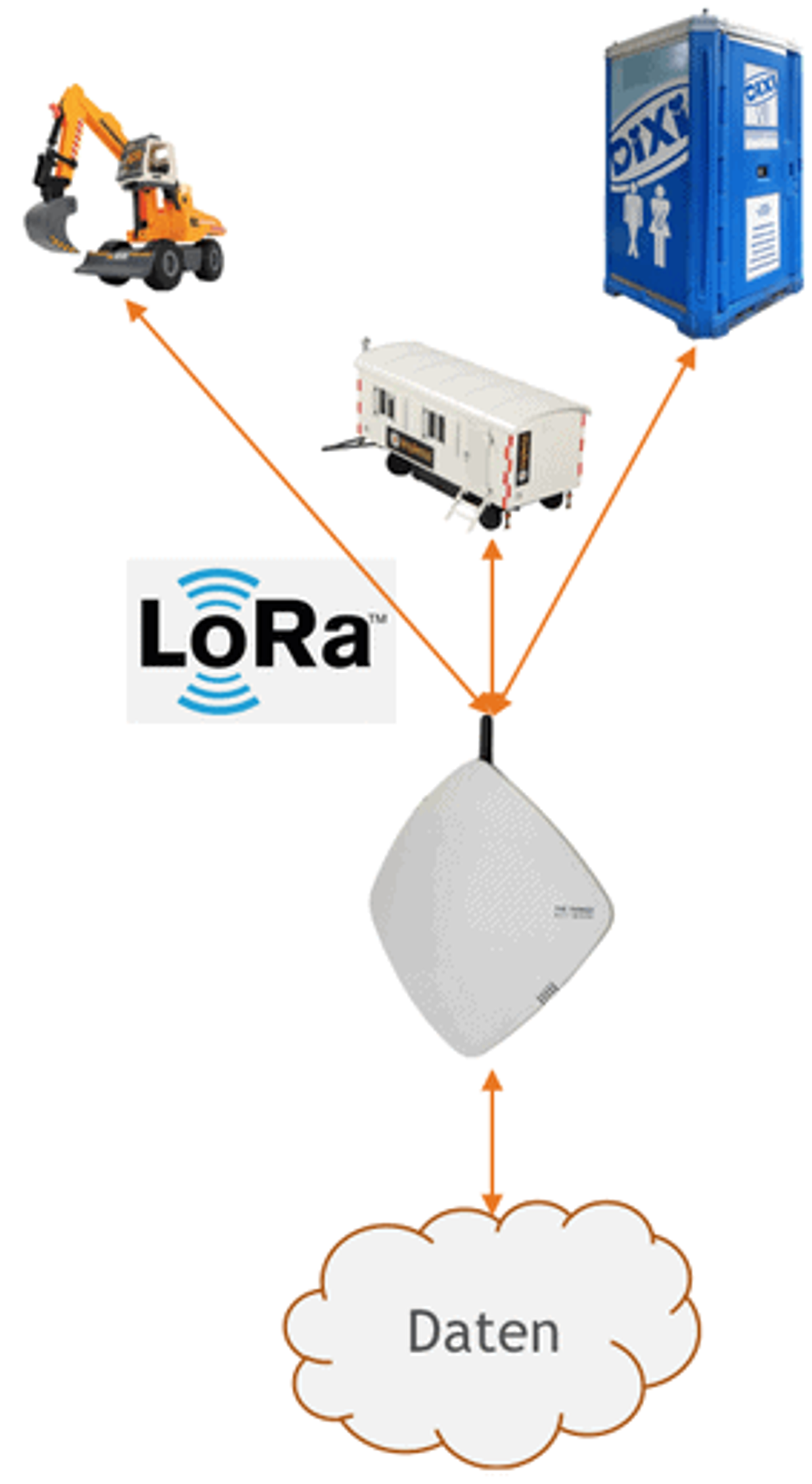
On the construction site, work is being done in many places simultaneously, materials and tools disappear, and equipment is untraceable. Sometimes unexpected material problems occur due to temperature fluctuations, or the portable toilet is full. All this causes additional costs and dissatisfaction among employees. But that's over now. With a local LoRaWAN, the entire construction site can be easily monitored. If a device is not in its place, it can be located by a Sensor. Another Sensor monitors the temperatures on the construction site and reports critical values. Theft problems are also a thing of the past thanks to the network. From the construction fence to the containers, transmitters with alarm contacts are installed at all gates, doors, and windows, monitoring them in real-time. You or the security service will immediately receive a notification on your smartphone when a gate is opened. This leaves little time for intruders. Furthermore, networking the construction site contributes to employee safety. If lone workers are equipped with a dead man's alarm, help can be provided immediately in the event of an accident. And the full portable toilet is no longer a problem, as a Sensor for fill level measurement gives a timely signal for emptying. Thanks to the long-lasting batteries, the Sensors can be installed anywhere with little effort. And since Sensors can be easily added as needed, the network adapts to the requirements from construction site to construction site. And when a construction site is completed, the entire network can be taken to the next site.
Monitor wastewater systems without entering the sewer
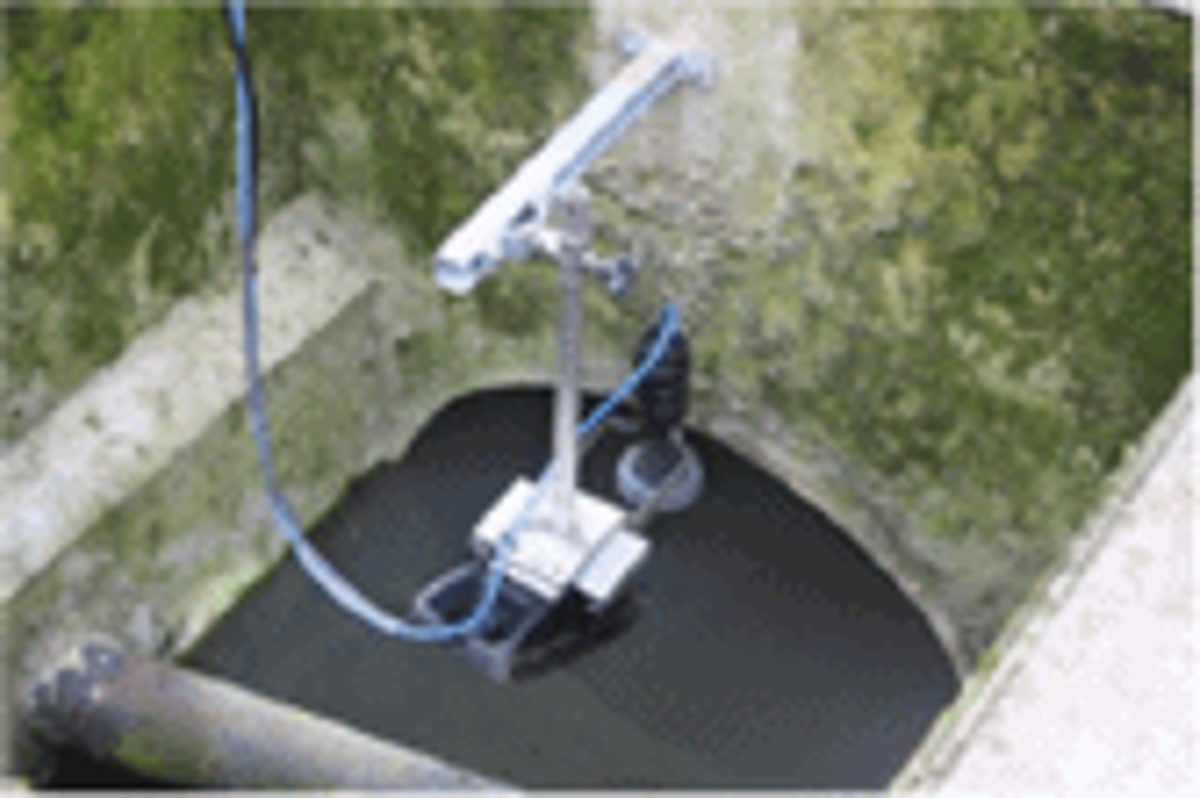
Currently, monitoring the wastewater system involves significant costs and time. At each measurement point, a construction site must be cordoned off, two wastewater experts must descend and determine the data. Then the construction site is dismantled, and the determined data is recorded. Thanks to LoRaWAN, this is now faster and with significantly less effort. Sensors are installed at the measurement points to measure water quantity, pressure, flow rate, temperature, etc., and send them automatically. All that remains is to evaluate the data. This saves considerable time and costs, and road traffic is not disrupted. LoRaWAN is particularly characterized by its high range, as it reliably transmits its data even in deep basements or shafts.
Connected agriculture or Smart Farming
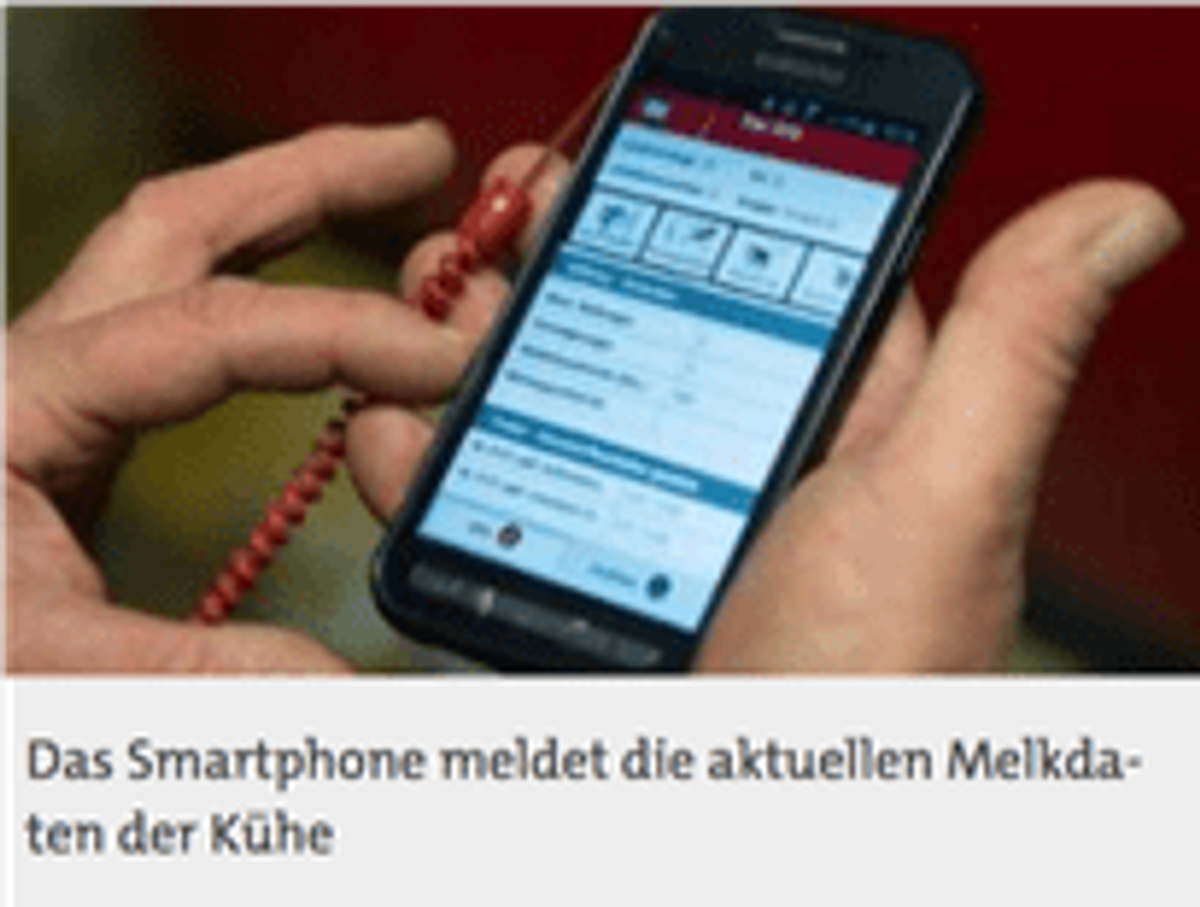
Every farm can set up its own LoRaWAN at relatively low costs. Sensors can monitor both fields with plants and animals to always ensure optimal conditions. An example of this is the health of livestock. Until now, it has been difficult for farmers to have a constant overview of the health status of their animals. Diseases often only become apparent when symptoms are visible, and the disease is already advanced. But even a small Sensor on the animal's ear helps. Now the farmer has all the data of the animals, such as body temperature, etc., in view at any time via their smartphone. In case of abnormalities, they can intervene directly. The high range and strong batteries make LoRaWAN the perfect technology for this, as the animals can move freely with the Sensors across the entire pasture. And no extra power connection is needed in the barn. Additionally, when expanding the herd, more Sensors can be added without needing an external provider. More on Smart Farming will be covered in our next blog.
Smart Town - building a city network with LoRaWAN
In the development of a city into a Smart Town, LoRaWAN offers a good complement to mobile networks. All applications that do not consume large amounts of data can run over the city's own machine network. Unlike using the mobile network, the city itself determines the area coverage here and can direct the collected data to the right people, apps, or offices depending on authorization.
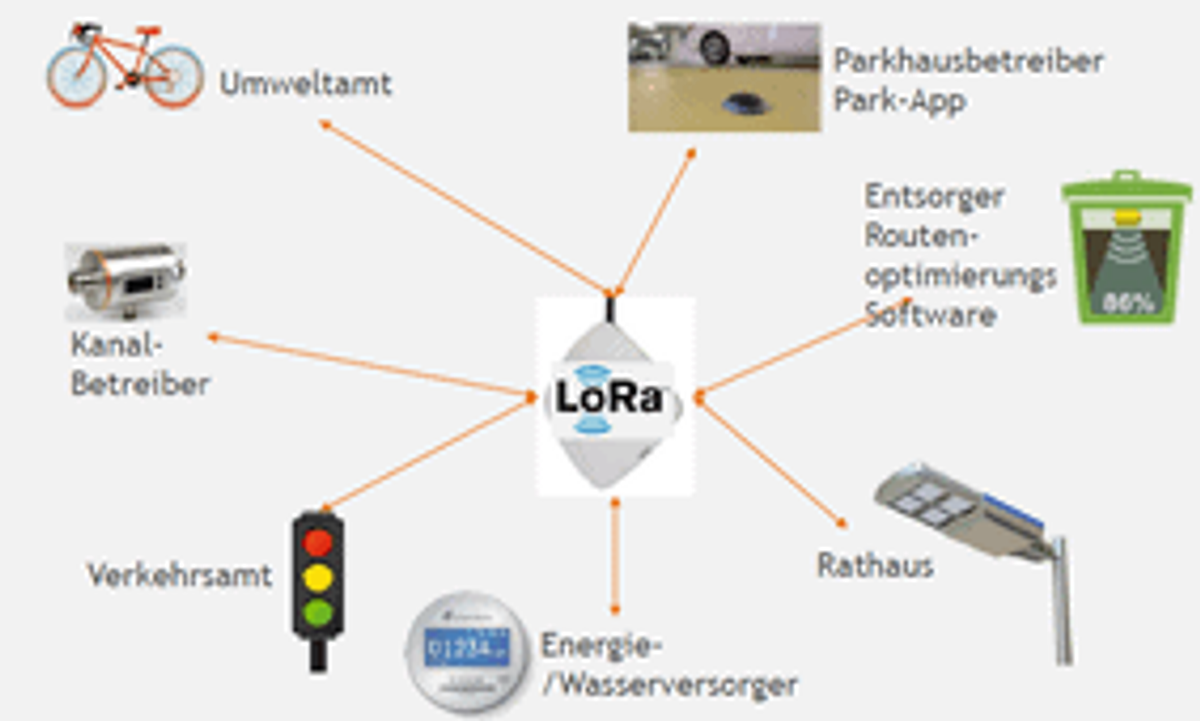
The wastewater data from the Sensors at the measurement points is received by the waterworks and sewer operators. The waste collection service is notified about the fill levels of the waste containers, allowing them to optimize their routes. An integration of smart electricity and water meters that transmit consumer data directly to the respective supplier is also possible. This eliminates the need for field service staff, and residents no longer have to wait at home for readings. Traffic and street lighting can also be optimized, saving energy and protecting the environment. Traffic light controls can be monitored by the traffic department, and street lighting can be transformed into Smart Lights. LoRaWAN Sensors can also be used for mobile fine dust measurement. If they are attached to bicycles, for example, they reliably transmit fine dust data to the environmental agency while on the move. In short - why LoRaWAN is interesting for you Here are the advantages of LoRaWAN for you in a nutshell:
- Network coverage can be determined by yourself
- Mobile and flexible use
- No transmission costs
- Independent of mobile network providers
- High range and low energy consumption
We are happy to work with you to determine the potential of LoRaWAN as an alternative or as a complement to other transmission technologies. Learn more about ECBM's services here: https://www.ecbm.me
A guest post by Elisabeth Schloten, Managing Director of ECBM Connected Business Models.

"Driving digitalization forward in Germany is my passion. When we talk about Industry 4.0, it often involves Cyber Physical Systems. A combination of mechanical-physical machines that, through software and networking, can achieve more than conventional production facilities. Germany is excellently positioned in mechanical-physical systems and has a great history in computer technology. However, if we are not careful, we will be quickly overtaken in the coming years by companies from countries and cultures that do not work with the same perfectionism and therefore achieve results faster. I want to help the German Mittelstand and its municipalities use today's technologies to solve tomorrow's problems with my team."