LoRaWAN Range, Part 1: Key Factors for Good Radio Range
Optimize the radio range of your LoRaWAN network. Discover the key factors for optimal performance.
This blog post describes the physical properties of radio networks - specifically those of LoRaWAN technology - in relation to range. The presented information supports the planning process and the evaluation of use cases of LoRaWAN. Part 1 of the article explains the factors and their relationships that influence radio range.Part 2 "Range and Coverage of LoRaWAN in Practice" shows and evaluates separate measurement examples from the real environment. In radio technology, there are essentially three properties that characterize a network:
- the range/distance,
- the data transmission rate and
- the energy consumption.
It is difficult to account for all three criteria with equal weighting
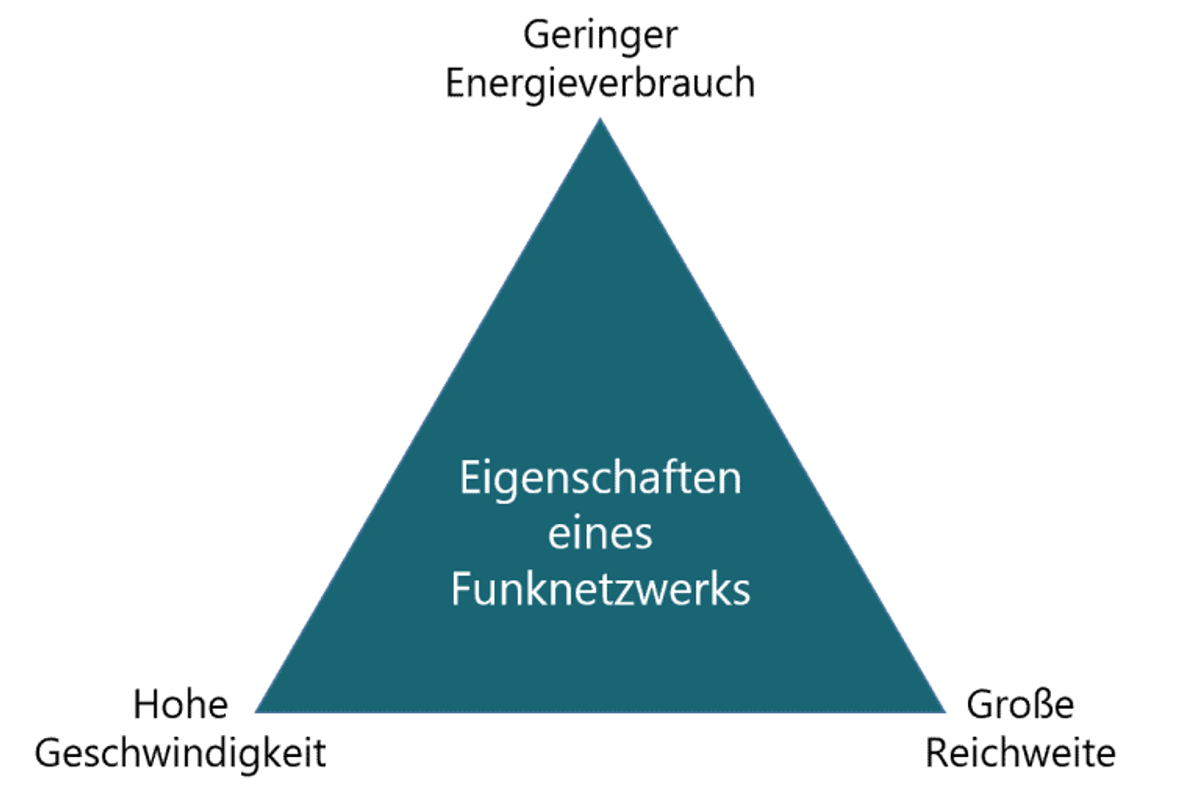
because physical laws set clear limits: For example, LoRaWAN can transmit data over long distances and requires relatively little energy, but has only a low data rate. WiFi and Bluetooth, for example, achieve very high data rates, but the energy consumption is comparatively high and the range is very low. All smartphone users are well aware of this energy hunger. The base stations of large telecommunications providers offer high data rates and relatively high ranges, but a large amount of energy must be available for this. Therefore, power supply is always a very important planning factor for such installations.In practice, optimization is possible for a maximum of 2 of the above criteria. - A decision must always be made as to which properties have priority.
The Link Budget
The Link Budget, (or the so-called power transmission balance) indicates the quality of a radio transmission channel. Using a simple model, the Link Budget can be calculated by adding the transmitter power (Transmitter Power, Tx), the receiver sensitivity (Receiver Power, Rx), the antenna gain and the free space path loss (Free Space Path Loss, FSPL). In the further course, the Link Budget of LoRaWAN is calculated.
The Path Loss
The path loss indicates how much energy is lost over a distance between Tx and Rx in free space. The greater the distance between Tx and Rx, the lower the energy. The path loss is usually represented as follows:
FSPL = (4πd/λ)2 = (4πdf/c)2 (1)
where:
FSPL = Free Space Path Loss d = distance between Tx and Rx in meters f = frequency in Hertz
There is also a widely used logarithmic calculation formula for free space path loss:
FSPL (dB) = 20log10(d) + 20log10(f) - 147.55 (2)
Doubling the distance (d) thus means 6dB of loss (in free space).
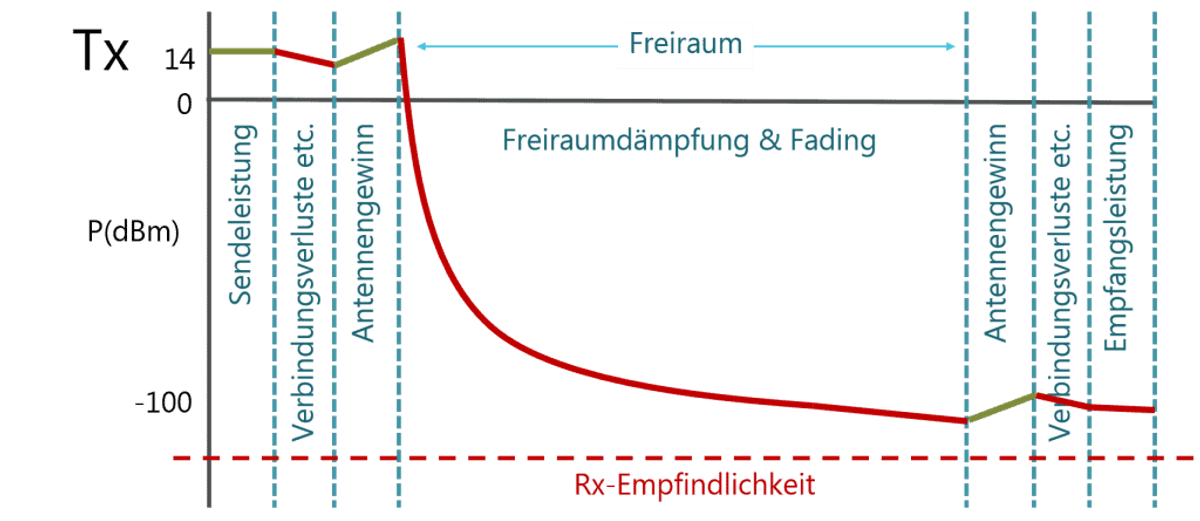
On the receiver side (Rx), the sensitivity of the receiver is the factor that influences the Link Budget. The so-called Rx sensitivity refers to the minimum possible reception power and tolerance for thermal noise and is calculated as follows:
Rx Sensitivity = -174 + 10log10(BW) + NF + SNR (3)
where:
BW = bandwidth in Hz, NF = noise figure in dB, SNR = signal-to-noise ratio (signal to noise ratio). It indicates how far the signal must be above the noise.
The Rx sensitivity in LoRaWAN is higher - and thus better - than, for example, in WLAN. Formula (4) shows the extreme case of path loss without including antenna gain and other types of free space path loss:
Link Budget = Max. Rx Sensitivity (dB) - Max. Tx Power (dB) (4)
An example of calculating a LoRaWAN Link Budget:
Tx Power = 14 dBm BW = 125KHz = 10log10(125000) = 51 NF = 6 dB (the gateways in LoRaWAN networks have lower NF values) SNR = -20 (for SF=12)
These numbers entered into formula (3) result in an Rx sensitivity of -137 dBm
Rx Sensitivity = - 174 + 51 + 6 - 20 = -137 dBm
The Link Budget can then be calculated as follows with formula (4):
Link Budget = -137dB - 14dB = -151dB
With the given values, a LoRaWAN Link Budget of 151 dB is achieved. With the Link Budget specific to LoRaWAN of 150 dB, a distance of up to 800 km can be overcome under optimal conditions (pure free space path loss). The current LoRaWAN world record is a range of 702 km.Under real conditions, these ideal values are of course not achieved. This depends on several factors.
Factor Free Space Path Loss
By doubling the distance, the free space path loss for LoRaWAN increases by 6 dB, so the attenuation of radio propagation follows a logarithmic function (see formula (1)). In addition to energy loss depending on distance, factors such as reflections and refractions of radio waves on objects can lead to superpositions of radio waves, which can also negatively affect the range. (Note: These relationships are very well explained in the video "LoRa crash course" by Thomas Telkamp from position 15:41.)
Factor Structural Attenuation
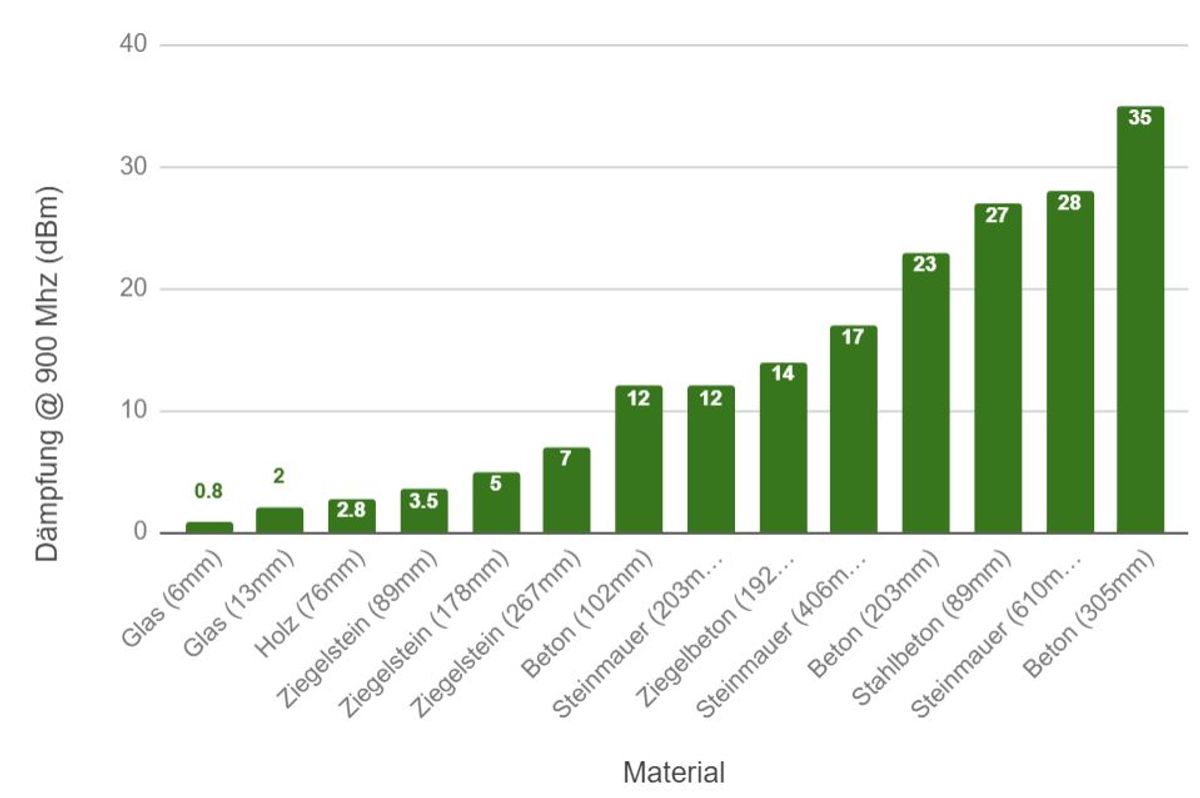
The structural attenuation, i.e., the attenuation of radio signals when penetrating different obstacles, influences the reception of transmitted signals and leads to a significant shortening of the range. For example, glass attenuates with just 2dB. This affects the range much less than a thick concrete wall of 30 cm. The table below lists various materials and their typical attenuation.Material Attenuation (dB) Glass (6mm) 0.8 Glass (13mm) 2 Wood (76mm) 2.8 Brick (89mm) 3.5 Brick (178mm) 5 Brick (267mm) 7 Concrete (102mm) 12 Stone wall (203mm) 12 Brick concrete (192mm) 14 Stone wall (406mm) 17 Concrete (203mm) 23 Reinforced concrete (89mm) 27 Stone wall (610mm) 28 Concrete (305mm) 35
Factor Fresnel Zone
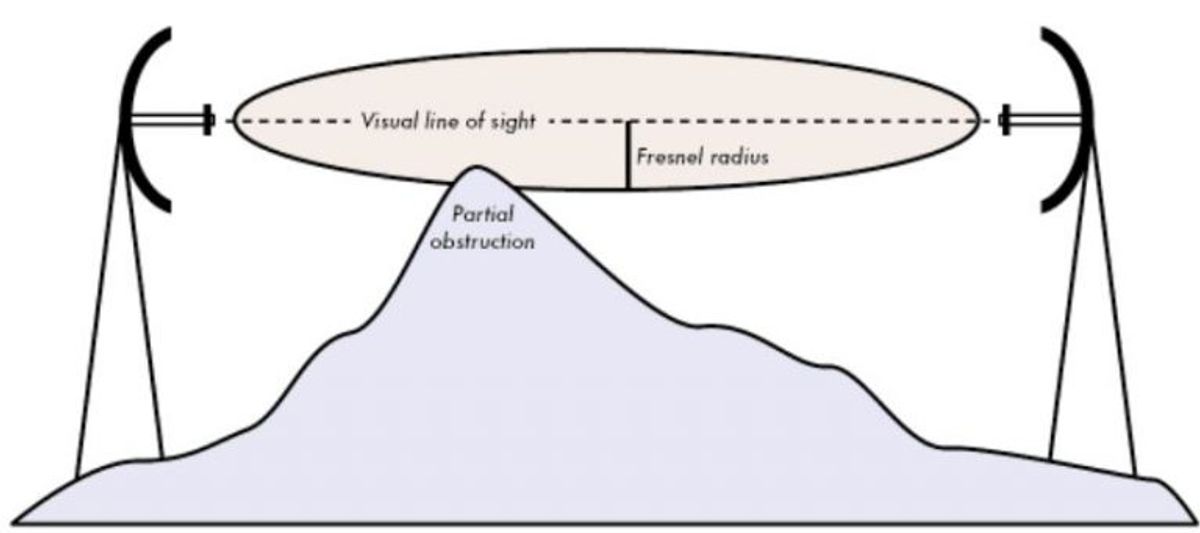
To effectively cover long ranges and achieve a good Link Budget, it is also important to establish a line of sight between the transmitter and receiver as often as possible. In radio transmission, certain spatial areas between the line of sight are referred to as Fresnel zones. If objects are located in these zones, they can have a negative impact on wave propagation, even though there is generally line of sight between the transmitting and receiving antennas. For any object located in the Fresnel zone, the signal level is reduced and the range is decreased (see figure).
In LoRaWAN networks, omnidirectional antennas are usually used. This spreads radiated energy on the horizontal plane where the network nodes and gateways are located. In Europe, the transmission power limit of an ISM band is defined as 14 dBm for a frequency of 868 MHz. Additionally, the maximum antenna gain is set at 2.15 dBi.
Factor Spreading Factor
A LoRaWAN network uses Spreading Factors (SF, spreading factors) for specific adjustment of the data transmission rate versus range. In LoRaWAN networks, SF7 to SF12 are used. LoRaWAN networks are resistant to interference, multipath propagation, and fading (referred to as fading in electrical engineering) due to their Chirp Spread Spectrum modulation and various phase-shifted frequencies used for chirps. Chirps are used to encode data on the Tx side in LoRaWAN networks, while inverse chirps are used on the Rx side for signal decoding. The aforementioned SFs indicate how many chirps per second are used and define bit rates, energy per symbol, and achievable range. SF9, for example, is 4 times slower in terms of bit rates than SF7. The scalability of LoRaWAN is achieved through SFs. The slower the bit rate, the higher the energy per data set and the range. LoRaWAN supports automatic adjustment of SF factors depending on the network configuration, known as Adaptive Data Rate (ADR).
Summary
- The Link Budget determines the maximum range of a LoRaWAN network.
- The free space path loss affects the range. By doubling the distance, the free space path loss increases by 6 dB.
- Reflections and refractions of radio waves on obstacles and the ground affect signal levels and range. In the LoRaWAN network, one side of the radio connection is usually near the ground.
- Obstacles in the first Fresnel zone affect the signal level on the Rx side and shorten the range.
- SF values and thus the range of a transmitter depend on the propagation conditions. LoRaWAN allows automatic network management via ADR and thus regulates the ranges of the transmitters.
- The Rx sensitivity depends on signal-to-noise ratio (SNR), noise figure (NF), and bandwidth (BW).
Strategies for Range Optimization in LoRaWAN
The following points should be considered to improve the range in a network with LoRaWAN technology:
- Location of the Gateway: Ensure optical visibility between the Tx and Rx antennas. Increase the height of the antennas to achieve optical visibility between the antennas. The use of outdoor antennas is always better than indoors.
- Choice of Antenna: Classic rod antennas concentrate energy on the horizontal plane. Avoid obstacles in the immediate vicinity of the antenna. Additionally, they should always be mounted on a mast rather than on the side of the building. The range should improve if the antenna is carefully selected and the antenna polarization and maximum defined antenna gain are optimally aligned.
- Choice of Connection Material: Use quality connectors (N-connectors) and cables (LMR 400 or equivalent, with a loss of less than 1.5 dB per 100 m). To reduce the loss in the connection material, the length of the connection between the station and antennas should be kept as short as possible.
- Installation near other radio systems: Avoid strong interference, for example, from surrounding GSM or UMTS stations. Refer to the manufacturer's manual for this (usually found under the term “co-localization”).
- In general, it should be briefly mentioned in this context that the installation of a LoRaWAN gateway should pay attention to sufficient surge and lightning protection.

If you have further questions on this topic, you can contact us at any time. This is the first of two article parts. The 2nd part will cover real transmission distances in various urban scenarios.