10 Facts How the Internet of Things Intelligently Changes Logistics
Discover intelligent logistics and learn more about the 10 key facts showing how the Internet of Things is revolutionizing and optimizing the logistics industry.

Online orders have become an integral part of our daily lives. Goods ordered with just a few clicks are sometimes shipped around the globe and arrive at your doorstep shortly thereafter. The logistical processes in the background must be made increasingly efficient for reasons of time and cost. The Internet of Things (IoT) contributes significantly to this growth with state-of-the-art technologies, enabling intelligent logistics to stay one step ahead of customer demands.
This article shows why the Internet of Things is essential for future competitiveness in logistics.
Real-time tracking and visibility through IoT
The transparency of GPS data can optimize transport processes. In addition to cost savings, there are further advantages for all parties involved. The entire transport process becomes more predictable and can run more smoothly. In particular, the calculation of the arrival time becomes more precise.

Staff planning is also simplified, so that more capacities are needed for a larger delivery. Or the driver already knows which loading dock to approach before arrival. Especially with just-in-time deliveries, this form of intelligent logistics is indispensable. Real-time transmission of the location and status of the delivery is essential for a smooth process. In addition, intelligent logistics allows for proactive action.
Fleet management and optimization through intelligent logistics systems
Not only deliveries and goods can be optimized through the Internet of Things and intelligent logistics. The fleet can also benefit. Outdated Excel spreadsheets or even paper tables are inefficient and confusing. Intelligent logistics solutions save time and costs by automating processes and expanding them with additional possibilities. Especially the live transmission of vehicle status and location ensures much more precise planning and increases the utilization of the vehicle fleet. Predictive maintenance of vehicles reduces unexpected breakdowns. At the same time, the new data basis enables better handling of unplanned situations.
Warehouse automation and efficiency through smart logistics applications
The Internet of Things and smart logistics applications are revolutionizing warehousing. Immense cost savings and efficiency increases in the same space are possible. An intelligent warehouse today automatically scans incoming goods. The optimal storage location is automatically digitized and, depending on the equipment, even transported to the chosen storage location without personnel involvement. At the same time, the goods are linked to the storage location, ensuring complete transparency over the entire warehouse at all times. Storage and retrieval are optimized and fully autonomous.
The IoT technology used in Intralogistics 4.0 provides real-time tracking data and enables order picking.
By using intelligent logistics, a warehouse can utilize the available space more efficiently, accelerate and automate processes. At the same time, the planning effort is almost completely eliminated and efficiency is significantly increased.
Increased security and theft protection through IoT
Smart logistics solutions and IoT are capable of detecting potential disruptions and security risks early on through various sensors. For example, sensors are used on rails to monitor the condition of train wheels and warn of derailment risks. This can significantly reduce safety and cost risks.
Intelligent logistics solutions can also help prevent theft. This works, for example, by monitoring warehouses with camera systems or sensors on truck doors. In case of danger, the police can be automatically alerted, or the stolen goods can be tracked afterwards.
Thus, smart logistics can identify and counteract security risks. Especially in cases of theft (attempts), there is a quick risk to the goods or personnel. In 2016, cargo theft caused damage of 2.2 billion euros in Germany. Investments in smart logistics applications could reduce this number in the future and at least deter potential perpetrators.
Dynamic supply chain management through smart logistics
The Internet of Things is also capable of optimizing supply chains. In particular, the transparency created by the data obtained can increase efficiency and reduce costs. By tracking and monitoring transports and shipments, for example, delivery delays or even impending production outages can be responded to more quickly.
Furthermore, new business fields, such as additional services, can be tapped, as intelligent logistics can act much more dynamically than conventional, mostly static processes.
Environmental monitoring and compliance through IoT
Depending on the location, different environmental regulations apply. IoT can ensure that existing resources are better utilized to comply with regulations without major investments. At the same time, smart applications facilitate monitoring.
For example, farmers can use intelligent irrigation systems to monitor the environment using IoT sensors. This way, specific areas with special needs can be identified. The automated irrigation system can then water dynamically, significantly reducing water waste and environmental impact.
Last mile innovations through Logistics 4.0
The last mile is often a major problem for logistics, as goods must be distributed to each end customer, significantly increasing the cost per ton. An example of Logistics 4.0 is a startup called Zipline. The company uses small, electrically flying drones and airplanes to deliver goods directly to any location. By using IoT systems and mostly automated processes, delivery times of often under 30 minutes within a 60km radius are achieved.
Intermodal transport optimization through smart logistics
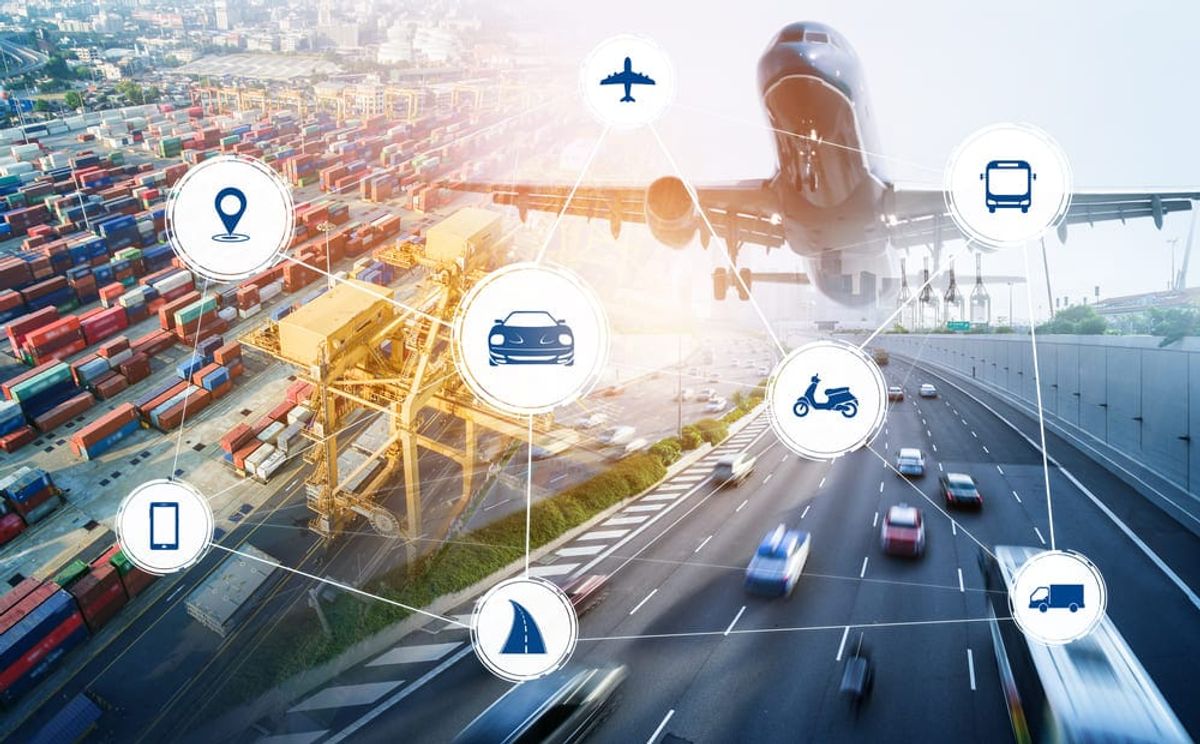
Deliveries are often transported with multiple modes of transport, for example, for cost reasons or due to geographical conditions. The optimal linking of several links in the transport chain requires high efficiency and precision. IoT can enable these conditions through location and other necessary real-time data.
Adaptation and personalization of logistics services through intelligent logistics applications
Changing or personalizing logistics processes spontaneously required a high planning effort. Today, this can be done with just a few clicks. Smart logistics applications make it possible to adjust deliveries at any time if necessary, for example, in the case of an unplanned stopover of a truck. Personalized requests can also be calculated and implemented efficiently and cost-effectively. Customer satisfaction increases immensely due to such dynamic adaptability.
Integration with other new technologies
Once a company begins to integrate intelligent logistics applications, IoT, etc. into its processes, it becomes easier to implement other technologies. Especially with the increasing acceptance of IoT applications over time, new technologies are designed to be as compatible as possible. Interfaces that still have to be implemented manually today may sooner or later be offered by the software provider as standard.
Intelligent logistics: IoT increases efficiency and competitiveness
The highly complex processes of the logistics industry benefit greatly from the use of the Internet of Things. In particular, real-time data and adaptability enable more efficient and effective intelligent logistics processes. A logistics company that forgoes these advantages is already or will soon be unable to grow and compete beyond a certain size. Start integrating IoT into your logistics processes now.