What is RTLS? Real-Time Locating System explained simply
A production order is supposed to start, but the appropriate load carrier is not where it should be. So an employee walks through the hall, through the pre-assembly, past the buffer space, until the sought container appears between two rows. A colleague had placed it there shortly before the end of the shift without booking it. The system still showed a location that was no longer correct. Anyone who knows this scene knows the problem that an RTLS solves better than any definition could describe.


What is RTLS?
RTLS stands for Real-Time Locating System. It automatically shows where your load carriers, tools, and equipment are located at any time within defined areas such as halls, warehouses, the factory premises, or in contexts like hospitals. Depending on the radio technology, the accuracy ranges from a few centimeters to several meters.
A realistic comparison you might know from private life is the navigation system in a car: It always knows where you are and shows the location on a map. An RTLS does the same, but not for a car on the road, rather for hundreds of movable objects in your hall.
Why manual recording reaches its limits
Without continuous tracking, the knowledge of the locations of your load carriers hangs by two thin threads: the memory of experienced employees and manual scanning. Both only hold as long as someone actually scans or remembers. As soon as the pressure increases or the shift changes, gaps arise. The inventory in the ERP or warehouse management system does not reflect the actual inventory, and no one notices until the search through the hall begins. Because a position where the container was last scanned is not necessarily the same position that is still current.
How does an RTLS work?
An RTLS reverses the principle: Instead of a person recording where something is, the asset reports itself. Three components work together for this.
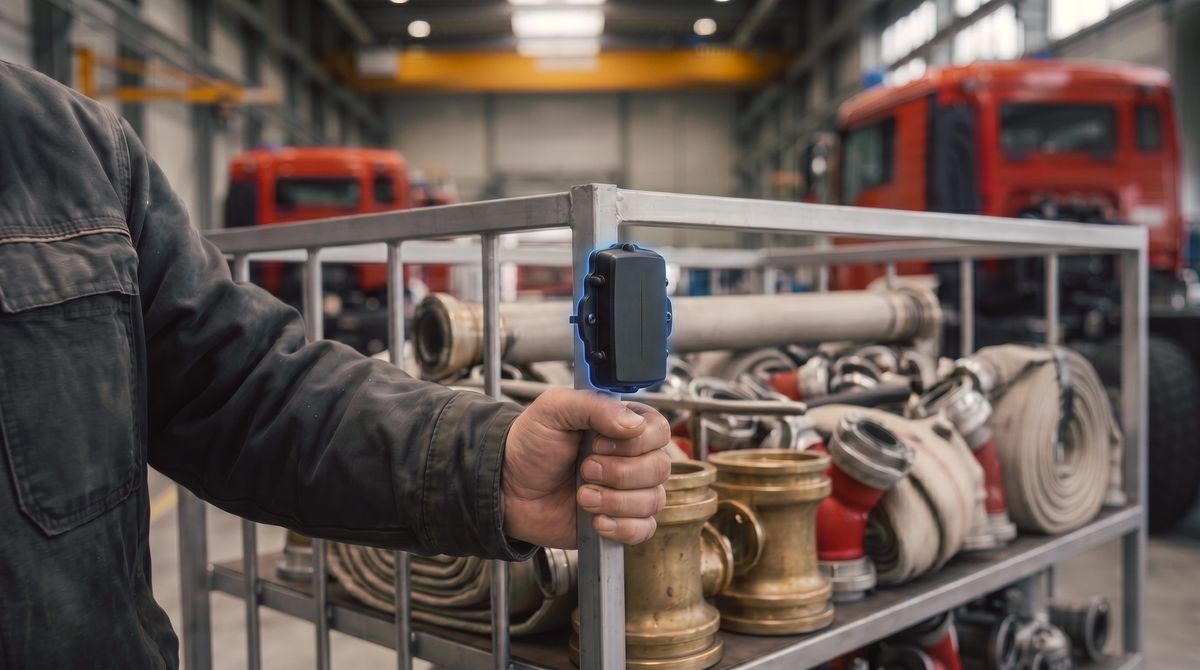
The transmitter on the object: A small radio transmitter, known as a tag, is attached to every load carrier, order box, tool, or container you want to track. You can think of it as an electronic name badge that sends out a signal at regular intervals: "I am here." These tags are usually battery-powered, small, robust, and designed for the harsh conditions of a hall.
The receivers in the room: Fixed receiving stations, comparable to mobile phone masts, are distributed throughout the hall and premises to capture the signal from your phone. These stations receive the signals from the tags and calculate where the respective object is located. Depending on the technology, this is done via the runtime of the radio signal or the signal strength at several receivers simultaneously.
The platform: The calculated positions are centrally collected and displayed on a digital map of your operation and, just as importantly, passed on to your existing systems. From thousands of individual "I am here" signals, a continuous, living image of your operational world is created: a digital twin of what is actually happening in the hall.
Which radio technologies are used in RTLS?
A reliable RTLS is not tied to a single radio technology. It uses the appropriate technology for the respective area.
| Technology | Typical Accuracy | Environment | Infrastructure Effort | When is it useful? |
|---|---|---|---|---|
BLE | 1 to 3 meters | Indoor, area-specific | low to medium | Asset tracking at area/storage location level |
UWB | 10–30 cm (decimeter to cm range) | Indoor, high precision | high | Use cases with centimeter-accurate positions |
WiFi | 3–15 m | Indoor | uses existing infrastructure | with existing strong WiFi coverage |
RFID (passive) | spotty, no real-time | Indoor, at reading point | low | simple capture at gates/stations |
GPS | 5 to 10 meters | Outdoor | no additional infrastructure | tracking outdoors and in transport |
Typical Accuracy
BLE
1 to 3 metersUWB
10–30 cm (decimeter to cm range)WiFi
3–15 mRFID (passive)
spotty, no real-timeGPS
5 to 10 meters
Environment
BLE
Indoor, area-specificUWB
Indoor, high precisionWiFi
IndoorRFID (passive)
Indoor, at reading pointGPS
Outdoor
Infrastructure Effort
BLE
low to mediumUWB
highWiFi
uses existing infrastructureRFID (passive)
lowGPS
no additional infrastructure
When is it useful?
BLE
Asset tracking at area/storage location levelUWB
Use cases with centimeter-accurate positionsWiFi
with existing strong WiFi coverageRFID (passive)
simple capture at gates/stationsGPS
tracking outdoors and in transport
The different radio technologies mainly differ in accuracy, range, and infrastructure costs.
In practice, the crucial question is rarely "Which radio technology?", but rather "What accuracy do I need at which point and what is the cost?"
For most applications in production and logistics, it is sufficient to know in which zone, at which station, or on which buffer space an object is located. Locating the tag with centimeter accuracy (UWB) is technically possible, but often simply not necessary.
RTLS, GPS, RFID, and Barcode: What is the difference?
In discussions, several terms quickly come up that can easily get mixed up. The most important distinction in brief:
Barcode and classic RFID capture a status at a point in time, usually when passing through a gate or during a conscious scan. They answer the question "Was the object here?", but not "Where is it now?". They are snapshots, not continuous views.
GPS is ideal as soon as assets leave the factory premises, for example, to control container cycles across multiple locations or for overview in field operations. However, GPS does not work reliably inside buildings because the satellite signal does not penetrate the hall roofs.
RTLS precisely fills this gap: continuous real-time tracking within halls and premises. No gate, no conscious scan, no satellite, but a living picture of movement as long as the object is within the captured area.
In practice, these methods complement each other. For internal transparency, RTLS is the tool of choice. As soon as the journey goes beyond the factory gate, GPS tracking or condition monitoring of time-critical shipments takes over.
Where RTLS is particularly worthwhile
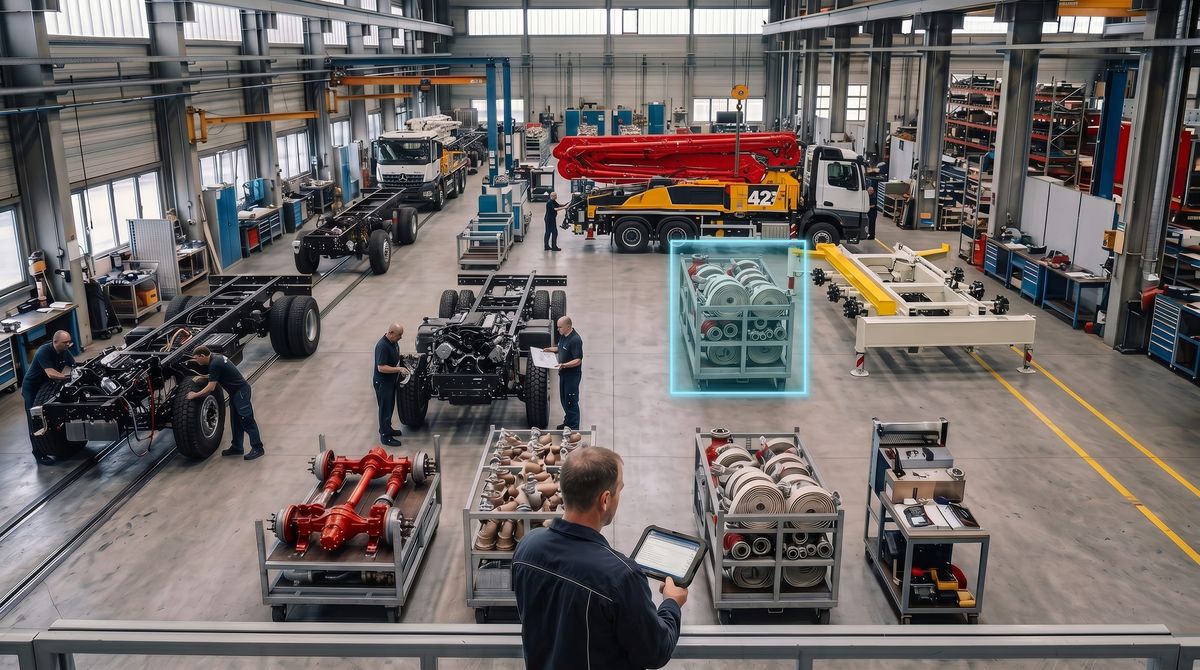
RTLS is most cost-effective where variability meets efficiency pressure, in High-Mix-Low-Volume Manufacturing (HMLV): many variants, small quantities. This very diversity makes classic automation difficult because the processes cannot be cleanly standardized while the cost pressure remains.
Ruthmann builds highly specialized work platforms and aerial work vehicles. Each unit is individually configured. Where each unit is different, rigid automation does not help, but transparency about where material, order, and tools are currently located does. Ruthmann, for example, was able to reduce search times in production by 90%.
Depending on the environment, the application looks different. In production and assembly, it is about keeping orders and materials flowing instead of searching for them.
In logistics and supply chain, load carriers and container cycles are the focus.
In customer service and field service, expensive equipment is distributed across many locations and vehicles.
And in hospitals and healthcare, staff search for devices instead of providing care.
Short checklist
If several of the following points apply to your operation, SmartMakers RTLS Tracking is worth a closer look:
- There are many movable load carriers, containers, or tools whose location is constantly changing.
- Your employees noticeably spend time searching, and you suspect that this time adds up.
- Manual scans and bookings are a recurring friction point, and the inventory in the system regularly deviates from reality.
- Rising labor costs make purely manual processes increasingly uneconomical.
- You face regulatory requirements that demand a seamless, verifiable audit trail, such as within the framework of the EU Digital Product Passport.
If few of these apply, such as in a highly standardized mass production with rigid, always the same paths, classic automation may be the better answer. RTLS shows its strength precisely where things do not always run the same way.
The bigger picture: Realtime Operations
RTLS is rarely an end in itself. It is a component of a larger promise best described as Realtime Operations: an operation where the physical world and digital systems finally speak the same language.
As soon as assets report themselves and status data automatically flows into your processes, work fundamentally changes. Your employees stop searching and start managing. The most capable forces in your organization no longer spend their time on low-value search and scan work, but on the qualified work they were trained for. This is not just a question of efficiency; it is a question of how attractive and modern your operation is for the talents you want to retain.
And it is the foundation for what comes next: Intelligent assets that proactively communicate their location, needs, and path through each process step are the prerequisite for future AI agents to orchestrate complex, variable processes. Those who create the data foundation today are building the foundation for tomorrow's automation.
Save over 1000 search hours annually with RTLS
Our customer Putzmeister saves over 1000 search hours annually in production by using the SmartMakers RTLS solution. How they achieved this is explained in the case study.
Learn about the Putzmeister CaseRTLS stands for Real-Time Locating System. It refers to systems that continuously locate assets in real time within a defined area.
Passive RFID captures an asset selectively at a read point, providing a snapshot. RTLS locates continuously and shows the current position.
That depends on the radio technology and ranges from a few centimeters to several meters. The SmartMakers solution works at 3 to 5 meters depending on the environment, which is sufficient for most applications in production and logistics.
Yes. For outdoor areas and transport, GPS is typically used, which can be combined with indoor technologies in a single system.
There is no generally best technology. The right choice depends on the use case, required accuracy, quantity, and environment. The requirement should determine the technology, not the other way around.